


|
The most significant eruptions |
|||||||||
Summary of the eruptive history of Mt. Vesuvius
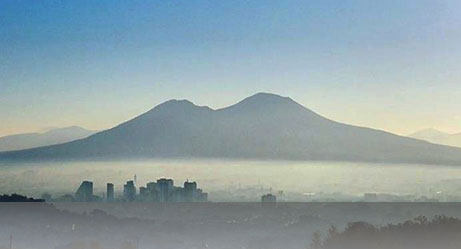
Mt. Vesuvius, or more correctly the Somma-Vesuvius complex, is a medium sized volcano reaching a height of 1,281 m above sea level at its highest point. It comprises the older volcano, the Somma, whose summit collapsed, creating a caldera, and the younger volcano, Vesuvius, which rises out inside of this caldera.
Volcanic activity in the Somma-Vesuvius area goes back at least 400,000 years, as shown by the age of lavas sampled at a depth of 1,345 m.
The history of Somma-Vesuvius volcanic edifice began almost 25,000 years ago,
with the growth of Mt. Somma due to predominantly effusive
eruptions, and subordinately low energy explosive
eruptions. This activity lasted up until about 19,000 years ago and resulted
in the formation of the volcanic edifice of Mt. Somma; its estimated profile
is shown in red in the image below (based on Cioni
et al., 1999). The northern part is partially preserved and forms Mt.
Somma.

Qualitative reconstruction of the original profile of the older volcano, Somma, (in red - based on the work of Cioni et al., 1999). Mt. Somma consists of the remains of the northern side of the old edifice.
The first plinian eruption of Pomici di Base (18,300 years ago) marked the begin of severe change in the shape of the Somma volcanic edifice, with the formation of a caldera due to the collapse of its summit. After this event, volcanic activity and later phases of collapse contributed to the formation of the younger volcano, Vesuvius. The activity of this volcano, which had grown inside the caldera of Somma, has been characterised by great variability both in styles of eruptions and in chemical composition of the magmas emitted.
Temporal diagram of Vesuvian activity. The vertical axis shows the number of years from the present, the horizontal axis, the V.E.I. (Volcanic Explosivity Index). For a description of V.E.I. click on the graph. For details regarding Vesuvius' major eruptions click on their name on the graph.
The eruptive history of Somma-Vesuvius can be subdivided as follows:
Volcanism older than 19,000 years
The huge Flegrean eruption of Campanian Ignimbrite had buried a large part of
Campania area under a thick blanket of tuffs, approximately 39,000 years ago.
The volcanic edifice of Somma began to grow on top of these deposits; its activity
was predominantly effusive,
and secondarily low energy explosive.
Volcanism between 18.000 and 16.000 years
This period is dominated by two great plinian
eruptions: the eruption of Pomici di Base
(18,300 years ago) and the eruption of Pomici Verdoline
(16,000 years ago). Lavas produced by small effusive eruptions has been found
between the deposits from these two eruptions. With the first Plinian eruption
of Pomici di Base, the collapse of the volcanic edifice of Somma began, with
the formation of a caldera inside
which the new volcano Vesuvius then grew.
| Volcanism between 8.000 years and 79 A.D: | |
|
During this period of activity there were three plinian eruptions: the eruption of Pomici di Mercato (8,000 years ago), the eruption of Pomici di Avellino (3,800 years ago) and the Pompei eruption (79 A.D.). These eruptions alternated with at least six subplinian eruptions, dated between the Pomici di Avellino and Pompei eruptions, and preceded by long periods of inactivity. |
Pompei archaelogical site |
Volcanism between 79 and 1631 A.D.
Activity in this period includes at least two subplinian
eruptions: the Pollena eruption (472 A.D.) and
the 1631 eruption, and a series of small, low-energy
effusive and explosive eruptions of medioeval age, causing lava flows on the
southern and western flanks of the volcano, and strombolian
scoria deposits.
|
Volcanism after 1631 |
The 1779 eruption (Volaire) |
The Vesuvius' wide variety of eruptive behaviours can generally
be attributed to the alternating of periods of open-conduit
activity and longer periods of quiescence with closed-conduit,
followed by major Plinian
or Subplinian eruptions.
The open conduit-periods are characterised by persistent strombolian
activity, frequent lava effusions and sporadic, but even more dangerous,
both effusive and explosive
eruptions.
|
|