


General overview

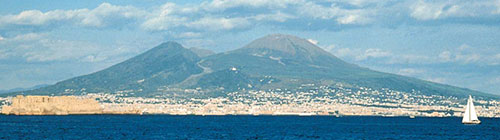
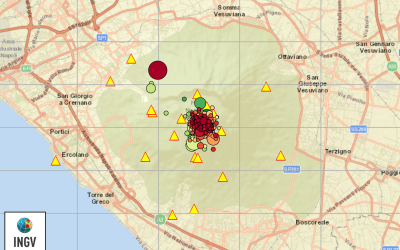
cratere_vesuvio.jpg (5032 byte)Vesuvius is an active volcano which erupted most recently in 1944. At present it is characterised by the presence of a hydrothermal system which feeds a fumarole field inside the crater, and which is the site of modest seismic activity with several hundreds of small earthquakes per year. Only the biggest of these is felt by the population resident in the area.

Seismic events are localized in the area of the crater, with ipocentral depths within the first 6 km, and with a magnitude that rarely exceeds 3.0 (MD max = 3.6). The spectral characteristics of the seismic events, the focal mechanisms and the waveforms suggests that the source mechanisms can be attributed to crust fracturing phenomena. Such events are defined as volcano-tectonic and are not directly associated with the movement of magma masses.

Up until 1944 Vesuvius was in an open conduit state and showed virtually permanent intra-craterial activity, alternating with frequent eruptions. Historical sources report that during that time, lasting almost three centuries, seismic activity was intense too, and the major eruptions were preceded by earthquake swarms which were distinctly perceptible by the population. Unfortunately scientific data are not available regarding this activity since observation using instruments was not yet existent.

The earliest systems for instrumental monitoring of seismic activity on Vesuvius date from the second half of the 1800's, when the Observatory was set up and thus the volcano, which was very active at that time, became a natural laboratory for experimentation with seismometric instruments. Vesuvius was one of the first, if not the first volcano in the world to house such instruments, albeit in embryonic form. However, the development of a modern surveillance system began in the seventies with the installation of the first stations of the seismic network; since then rapid progress has led to the present set-up.