


![]() |
Volcanism older than 39,000 years | ||
| Campanian Ignimbrite eruption | Neapolitan Yellow Tuff eruption | Bradisism |
Summary of eruptive history and ground deformations of Phlegraean Fields
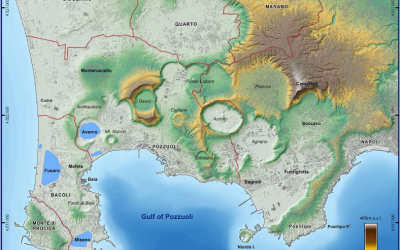
The Phlegraean Fields are a volcanic field where numerous, different eruptive centres have been active over the last 39,000 years. In its geological history there have been two major eruptions: the eruption of Campanian Ignimbrite (39,000 years ago) and Neapolitan Yellow Tuff (of 15,000 years ago). These eruptions are connected to two instances of subsidence, which together created a complex nested caldera; this is a clearly evident structure of the Phlegraean Volcanic District. This latter includes the Phlegraean Fields, the city of Naples, the volcanic islands of Ischia and Procida, and the north-west section of the bay of Naples.

Satellite photo of the Flegrean Volcanic District
The
beginning of volcanic activity in the Phlegraean area is not known precisely:
sequences of
lava and
pyroclasts of approximately 2 million years in age have been found in bores
between Villa Literno and Parete; the oldest outcropping volcanic products date
back around 60,000 years and consists mainly of
pyroclastic deposits and parts of
lava domes.
The volcanic activity can be subdivided as follows:
Volcanism older than 39,000 years
The rocks older than Campanian Ignimbrite are exposed only along the escarpments
bordering the Phlegraean Fields, and in a quarry situated on the north-east side
of the Quarto plain, where the pyroclastic
deposits of at least ten different eruptions are clearly exposed. Few of
the eruptive centres of these deposits are still visible today.
Campanian Ignimbrite (39,000 years):
eruption and caldera collapse
Campanian Ignimbrite is the product of the major
explosive eruption to have taken place in the Mediterranean area in the
last 200,000 years. This eruption, with its centre in the Phlegraean Fields,
buried a large part of Campania under a thick blanket of tuffs.
During the eruption a
caldera was formed which caused the subsidence of a vast area including
Phlegraean Fields, part of the city of Naples and part oh the bays of Naples
and Pozzuoli.
Volcanism between 39.000 and 15.000 years
The rocks erupted in the period between the Campanian Ignimbrite and Neapolitan
Yellow Tuff eruptions, are exposed along the rim of the Campanian Ignimbrite
caldera, within the city of Naples and along the north-west and south-west sides
of Posillipo hill. The eruptive centres were situated inside the Campanian Ignimbrite
caldera, both in the part of the caldera currently emerged and the part of caldera
at present submerged in the gulf of Naples.
Neapolitan Yellow Tuff (15.000 years): eruption and
caldera collapse
The eruption of Neapolitan Yellow Tuff is the second most important in the Campania
region. In the course of the eruption, several tens of km3 of magma
were emitted from a centre situated in the Phlegraean Fields, and an area of
approximately 1,000 km2 has been covered by pyroclastic deposits.
These deposits have been found in Neapolitan-Phlegraean area and the Campanian
Plain as far as the Appennines. The eruption of Neapolitan Yellow Tuff was accompanied
by the formation of a
caldera which caused the subsidence of an area including the Phlegraean
Fields and the bay of Pozzuoli.
Vulcanism youger than 15.000 years
The volcanism occurred after Neapolitan Yellow Tuff eruption is concentrated
in three periods of intense activity, alternating with quiescence. According
to the most recent studies, in the first epoch (from 1,000 to 9,500 years ago)
there were 34
eruptions, with an eruption on average every 70 years. In the second epoch
(from 8,600 8,200 years ago) 6 eruptions took place, with one eruption, on average,
every 65 years.
|
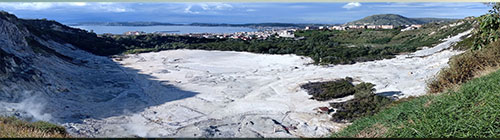
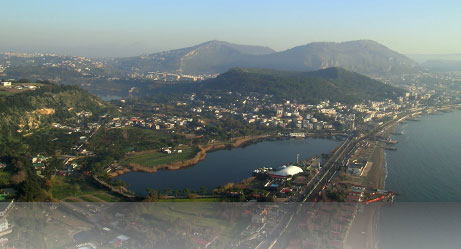
The crater of Monte Nuovo eruption of 1538, seen from above |
The third epoch (from 4,800 to 3,800 years ago) consisted of 16 explosive
eruptions and 4 effusive
eruptions, at an average frequency of one every 50 years. The most recent eruption was Monte Nuovo in 1538, after a period of quiescence which had lasted approximately 3,000 years and was one of the least violent eruptions experienced in the Phlegraean Fields area. |
Bradisism
From 1969-72 and 1982-84 the inhabitants of the Phlegraean area, and Pozzuoli
in particular, were witness to and victims of a phenomenon where the earth's
surface rose; whitin a few months it had risen by a total of 3.5 metres. This
phenomenon is called bradisism (literally a slow movement
of the earth's surface, as opposed to fast movement due to an earthqake). The
place which, more than any other, can be considered the evidence over the centuries
of Phlegraean bradisim is the macellum
(a market of the Roman period, better known as the Temple of Serapide) situated
close to the port of Pozzuoli. The remains of this building (which dates back
to the end of the first century A.D.) have been very useful in recostructing
the development of bradisism thanks to the holes made by lithodomes (sea molluscs
which live in coastal areas on the shore line between high and low tide) on
the columns which provide evidence of the variations in ground level as compare
to sea level, from the IV century A.D. onwards.
|
|
|
| The temple of Serapide in Pozzuoli in the late 60's. The floor, which is below sea level, bears witness of ground subsidence after its construction in Roman times |
The temple of Serapide in Pozzuoli today. The floor, which is above sea level, indicates that the ground has risen as compared with the 60's. |
Why this happens. Deformation connected with bradisism is due to chemical and physical variations linked to the evolution of the volcanic system in the Phlegraean Fields; this produces an increase in temperature and pressure in the rock above the magma chamber. The increase in pressure translate into a variation in stresses in the rock which leads to the characterisic lifting of the ground surface.
| |